
Circularity and art
How to interrupt a negative cycle

Last year, I asked one of my best readers if she had any topics she wanted me to cover. She told me that she wanted me to talk about the toxicity of art supplies. When I first started researching this topic, I was surprised by what I found. I think you will be, too.
Watercolor paints
Have you ever painted with watercolors? If so, have you ever poured your rinse water from painting down the drain? It turns out, you might want to rethink that action. Watercolor paints are made from a variety of ingredients, including, but not limited to, pigment, brightener, binder, plasticizer, humectant, extender, dispersant, and water according to this website. Was anyone surprised by the plasticizer? Yes, me, too! The article defines all the listed ingredients. According to the article, “Pigments are chemical compounds with appealing or useful color attributes and that do not dissolve in water.” Some companies make watercolor paints using different colors of soil as the pigment, although they still seem to contain concerning ingredients. How do you know what is concerning and what is not?
ASTM Standards
ASTM International is a standards body that has an “art materials industry subcommittee”. This committee sets standards for properties such as lightfastness or specifications for watercolor, acrylic, and oil paints. ASTM 4236 is the “Standard Practice for Labeling Art Materials for Chronic Health Hazards.”
Have you ever noticed a label on your art supplies that says “ACMI: Art & Creative Materials Institute Certified” and underneath it, “Comforms to ASTM D 4236”? The logo is a circle, and inside it might say “AP” or “CL”.
The AP label means the paints have been evaluated and certified as non-toxic. This article has a definition for non-toxic:
“A product can be certified nontoxic only if it contains no materials in sufficient quantities to be toxic or injurious to humans, or to cause acute or chronic health problems. AP certification is reviewed by ACMI’s Toxicological Advisory Board. These products are certified by ACMI to be labeled in accordance with the chronic hazard labeling standard, ASTM D-4236 and federal law P.L. 100-695.”
The CL label means it contains ingredients that are hazardous or toxic, but can be used safely with caution. Another label you might see on paints is the CA Prop 65 label, which indicates it has “chemicals that have been shown to cause cancer, birth defects, or other reproductive harm.” It is worth checking if your paints are labeled and, if so, what labels you are finding.
Acrylic paint
According to Wikipedia, “Acrylic paint is a fast-drying paint made of pigment suspended in acrylic polymer emulsion and plasticizers, silicone oils, defoamers, stabilizers, or metal soaps.” Acrylic paints and paint water should not be washed down the drain due to both microplastic content and potential toxicity. Interesting to note that acrylics became popular in the 1950s and 1960s because people didn’t want to wait for oil paints to dry. Acrylic paints dry in minutes compared to the longer dry time of oil paints.
My daughter let me know about a line of plant-based acrylic paints. The Natural Earth Paints Natural Acrylik Color are non-toxic and free of preservatives, solvents, synthetics, heavy metals, or fillers. They are made of 100% bio-based resins without petroleum-based ingredients (which means you won’t be washing plastic down your drain!). The label says it conforms to ASTM D4236, but the post I was looking at didn’t show an AP or CL label. If you are a fan of acrylics, it seems worth checking out.
Toxic chemicals in art materials
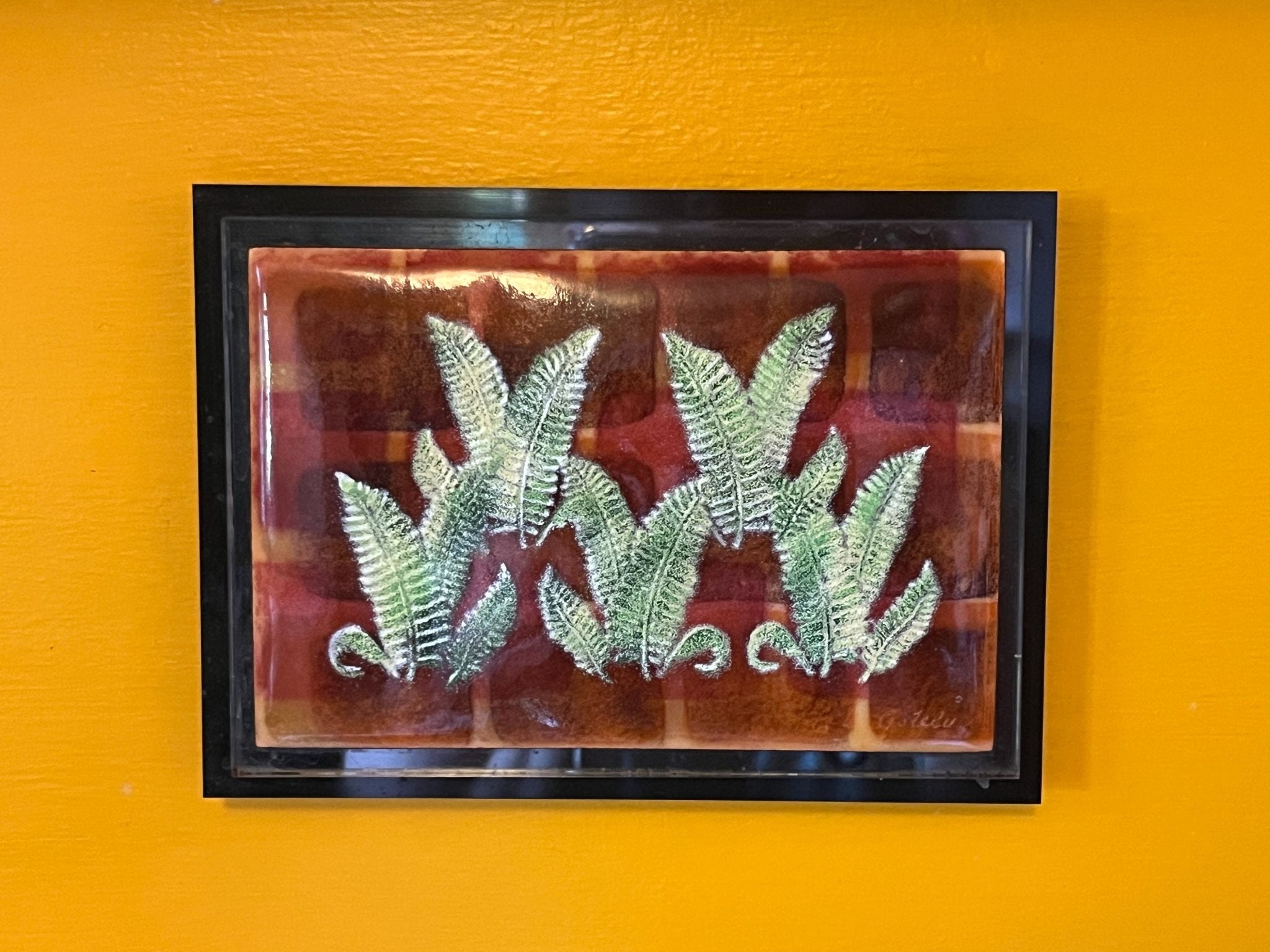
My mother was an artist who worked with glass pigments on metal, which, when fired in a kiln, created an enameled finish. When she got a new color, she would do a test, showing the new color layered over white, black, plain copper (her usual substrate), silver foil, and gold foil. I always loved those test pieces. When I was in college, her favorite company, Thompson Enamel, stopped making lead-containing enamels. They were the last company in the US to remove lead. My mother was very upset about this change, and she may have hoarded some of her powdered enamels. The change was made to keep people safe, but my mother loved the colors of the lead-containing enamels. Below is an original enamelled piece by my mother in a whimsical stencil phase. To my knowledge, it doesn’t contain lead.
You may have heard of popular paint colors like Cadmium Yellow or Cobalt Blue. Guess what? They contain heavy metals, which are definitely toxic. I have a large number of old watercolor paints, and I am sure that some are toxic. It is time to see what I have and whether anything is labeled as concerning. It might be a good time for you to take a look at your paints.
Latex paint
Latex paint is a type of acrylic paint specially formulated for painting walls and contains plasticizers. I was chagrined to think of all the times I have washed paint off brushes, which went down the drain. What can you do with a large amount of paint? This article shows a three-bucket solution that minimizes or eliminates paint down the drain.
Oil paints
Oils use linseed oil as the vehicle and binder of pigment. Unfortunately, many traditional pigments are made from toxic chemicals. While dried oil paints are waterproof and long-lasting, they are solvent-based, meaning clean-up traditionally required strong solvents like turpentine. However, there are solvent-free options for clean up. One of which can be found here. I remember my dad, who was also an artist, keeping brushes in a jar of turpentine indefinitely. I assume he cleaned the brushes off and covered the jar to stop evaporation. At least I hope so!
Cleaning up
If I haven’t made it clear, you shouldn’t pour your rinse water down the drain. If you do, you add microplastics and toxic materials such as heavy metals to your water supply. So what can you do instead? For water containing acrylic particles, I’ve read that you can let your paint water sit overnight. It should separate naturally. Then you can pour off the clear water and dispose of the old paint in the garbage. For water containing watercolor particles, you can let the water evaporate, leaving you with weirdly colored paint! It might be fun to try to use the dried paint. If you don’t want to paint with it, you can place it in the garbage. You know I am not a huge fan of putting things in the garbage…there is no “away”, but at least you can avoid putting these potentially toxic materials directly into the water supply.
Circularity and art
The subtitle for this post is “how to interrupt a negative cycle.” The negative cycle I am referring to is toxicity in art. With information, such as the ASTM and CA Prop 65 logos, you can make good decisions about the art materials you expose yourself to. By understanding that you shouldn’t pour paint rinse water down the drain, you can make different decisions about how to clean up and properly dispose of paint. I encourage you to be artistic and express yourself! By educating yourself, you can keep making art, be safe, and interrupt the negative cycle of toxicity in art materials.
Thank yous
Thank you to:
my new paid subscriber (!) and
to one of my best readers for their topic suggestion!
You both know who you are. :)
Don't fingerpaint and don't put your brushes in your mouth!
Wow, this was such a great read!!